Move over Google Glass and Oculus Rift. Robot vision has been around for a long time.
James Cameron’s final battle with the Terminator occurs in a fully
Robotic factory with vintage Bots from the 1980’s. Here are some early
Robotic brains staring with the IRI 256.
This 1980’s Robot is based on the same brain as the original Mac but
with a zero wait state 1 MIP MC68000 version of the chip. It can
actually visualize objects in low-res grayscale. The company
published some interesting rules of Robotics. This microcomputer was
Torso mounted using a 4G, UNIX-based API called Robotic Control
Language. There was also a safety protocol inhibiting the Robot’s
behavior around its human handlers.
The company went broke right around the time they received a patent
for Robot Vision so it was assigned to a stronger company. Which brings
us to our next item. GE Fanuc
Thursday, June 30, 2016

Tuesday, May 31, 2016
Former Zilog Engineer Talks Prototype Survivor
I recently had a chance to ask a former Zilog engineer a few questions about his remarkable single board prototype I had just acquired for the C.C. "permanent collection". This single board computer provided a 16K reference design for 8-bit home computers and arcade games.
Zilog is one of the few platforms in the world where vintage collectors and active developers lust over the same toasted sand. The QUIP packaged Zilog Z8-02 made in 1979 commands $500 because it is not only highly collectible but in short supply for a replacement part.
Super-optimized ZNEO covers much of the same territory Intel's 8086 did back when the Battle of the 80's was raging but outperforms modern RISC. The company's current Icebox dev tools owe their existance to a prototype single board computer created in 1978 to test the 4MHz Z80A.
According to the retired engineer, "When CPU performance elevated from 2.5 MHz to 4 MHz, this hand-built wire-wrap prototype was built to verify the design improvements and validate the functionality under in-circuit emulation.
The emulator plugs into the CPU socket, providing the engineer a portal into the operation of the hardware and software. A boot prom allowed serial port access with an improvised DC-DC converter modified to provide the bipolar RS-232 output voltages. At the time, emulators were the best way to check out new hardware as they pioneered the debug tools now taken for granted.
Placed on the included display stand, this respectable and rare relic speaks to the heady days of the Microprocessor Revolution -- visible proof that the March of Progress found continuity through these kinds of steps -- prototype design and implementation for validation (prior to simulators).
History's critical path temporarily vectored right through this particular prototype board which spearheaded the drive for next-level performance in the competitive 8 bit CPU marketplace dominated by Intel and Zilog. It proved the process improvements to NMOS IC fabrication with 4" wafers could reduce the manufacturing costs as well as increase the raw processing bandwidth.

This board contains the very custom Zilog clock driver chip required to produce a clean 4 MHz square wave with sufficient amplitude. Only produced for the 4 MHz Z80 CPU prototypes."
The engineer recounted the glory days of the 8-bit CPU wars. "It was a time of excitement and revolution!" "Sharing with the like minded makes it exciting!"
In a follow-up email the engineer who lives on a small island off Washington State wrote a heartfelt remeberance about his former colleage who built the board.
Thank you very much for the interest in the historical roots of the Zilog board. Your expertise in this area is most satisfying!
When Zilog introduced the 4 MHz Z80A, there were several issues that arose. The first problem was the clock input requirements. The solution was to build a little two transistor driver hybrid IC which is the little blue sip on the lower left.
The 16 MHz oscillator gets divided by four by a TTL device (the 9316) and then presented to the CPU via the clock driver. That proved very useful for reliability.
The cpu socket was used in conjunction with an in-circuit emulator for code development and the resulting code is buried in the the 2716 eprom.
The board was actually built by a colleague who worked on support hardware and software while at Zilog. He died a few years ago, so this was part of his work product that he passed along to me prior to his passing.
He was a dear friend and his work helped shape the future of microprocessor based systems.
Zilog is one of the few platforms in the world where vintage collectors and active developers lust over the same toasted sand. The QUIP packaged Zilog Z8-02 made in 1979 commands $500 because it is not only highly collectible but in short supply for a replacement part.
Super-optimized ZNEO covers much of the same territory Intel's 8086 did back when the Battle of the 80's was raging but outperforms modern RISC. The company's current Icebox dev tools owe their existance to a prototype single board computer created in 1978 to test the 4MHz Z80A.
According to the retired engineer, "When CPU performance elevated from 2.5 MHz to 4 MHz, this hand-built wire-wrap prototype was built to verify the design improvements and validate the functionality under in-circuit emulation.
The emulator plugs into the CPU socket, providing the engineer a portal into the operation of the hardware and software. A boot prom allowed serial port access with an improvised DC-DC converter modified to provide the bipolar RS-232 output voltages. At the time, emulators were the best way to check out new hardware as they pioneered the debug tools now taken for granted.
Placed on the included display stand, this respectable and rare relic speaks to the heady days of the Microprocessor Revolution -- visible proof that the March of Progress found continuity through these kinds of steps -- prototype design and implementation for validation (prior to simulators).
History's critical path temporarily vectored right through this particular prototype board which spearheaded the drive for next-level performance in the competitive 8 bit CPU marketplace dominated by Intel and Zilog. It proved the process improvements to NMOS IC fabrication with 4" wafers could reduce the manufacturing costs as well as increase the raw processing bandwidth.

Z80 Verification Prototype
This board contains the very custom Zilog clock driver chip required to produce a clean 4 MHz square wave with sufficient amplitude. Only produced for the 4 MHz Z80 CPU prototypes."
The engineer recounted the glory days of the 8-bit CPU wars. "It was a time of excitement and revolution!" "Sharing with the like minded makes it exciting!"
In a follow-up email the engineer who lives on a small island off Washington State wrote a heartfelt remeberance about his former colleage who built the board.
Thank you very much for the interest in the historical roots of the Zilog board. Your expertise in this area is most satisfying!
When Zilog introduced the 4 MHz Z80A, there were several issues that arose. The first problem was the clock input requirements. The solution was to build a little two transistor driver hybrid IC which is the little blue sip on the lower left.
The 16 MHz oscillator gets divided by four by a TTL device (the 9316) and then presented to the CPU via the clock driver. That proved very useful for reliability.
The cpu socket was used in conjunction with an in-circuit emulator for code development and the resulting code is buried in the the 2716 eprom.
The board was actually built by a colleague who worked on support hardware and software while at Zilog. He died a few years ago, so this was part of his work product that he passed along to me prior to his passing.
He was a dear friend and his work helped shape the future of microprocessor based systems.
Saturday, April 30, 2016
First Network Switch : 1881 Paris Award Restored
Familiar to historically oriented science buffs is the 1879 patent issued for the first automatic telephone exchange to McTighe and Connelly Brothers. Previously lost is one of the copper second place medals received by the group at the first electrical exposition in Paris. It has all three of the participant's names misspelled.
Eight stations were set up to dial each other without intervention of a manual switchboard. McTighe the inventor of the automatic switch was also a lawyer at the firm. One hundred years later Onyx Systems (Same founder as Zilog) would make the first UNIX eight user microcomputer.
Eight stations were set up to dial each other without intervention of a manual switchboard. McTighe the inventor of the automatic switch was also a lawyer at the firm. One hundred years later Onyx Systems (Same founder as Zilog) would make the first UNIX eight user microcomputer.
Most of the exhibits from that time are lost to history but as fate would have it the partners law firm was located near the Smithsonian. The complete exhibit is preserved for future generations in the American History Museum although not currently on display.

Large copper second place medal awarded in 1881. Restored medal has less patina.

Blinkenlights are everywhere as even the lighthouse has a red-white flasher.
.
During the summer of 1881 the first science festival ever held for electrical devices was about to get underway in Paris. The setting was the Palace of Industry built by Emperor Napoleon III for the 1855 World’s Fair to rival the Crystal Palace in London.
American participants included a young Thomas Edison literally sweating problems with his long legged Mary Anne and Alexander Graham Bell phoning the opera two blocks away for a live telecast. The building was steamy hot under a roof of cast iron and plate glass. One half of the building was devoted exclusively to French electrical exhibits. A first ever congress of electrical engineers had gathered to sort out terms for Volt, Ohm and Amp while also testing light bulbs from Swan and Edison for the best efficiency.
American participants included a young Thomas Edison literally sweating problems with his long legged Mary Anne and Alexander Graham Bell phoning the opera two blocks away for a live telecast. The building was steamy hot under a roof of cast iron and plate glass. One half of the building was devoted exclusively to French electrical exhibits. A first ever congress of electrical engineers had gathered to sort out terms for Volt, Ohm and Amp while also testing light bulbs from Swan and Edison for the best efficiency.
Thursday, March 31, 2016
Caelus Memories Rewind
Attack of the clones could describe Caelus Memories' plug compatible drive that was built with the encouragement of IBM by ex-RAMAC employees in San Jose. The actuator bears a strong resemblance to the RAMAC 305 but with a fixed vertical movement.
A facility was purpose-built in 1967 a close distance from IBM's own San Jose plant. While Caelus got required licensing, IBM was hit in 1970 by the defection of Gene Amdahl, a company fellow who built a 370 compatible mainframe.
Drive technology changed rapidly as by 1973 the company was competing with Winchester drives and the floppy disk. Even the Greek god of invention was no match for obsolescence. The site where the factory once stood is now a medical test lab.
Monday, February 29, 2016
UNIVAC Mirror Memory
Ten years after the invention of thin film memory in 1962, UNIVAC Federal Systems develops a non-volatile. ceramic substrate called Mirror Memory.
Rescued from the the gold scrap pile comes this amazing cache of Mirror Memory produced by bendix corporation for Sperry Univac. No stranger to voluminous amounts of gold foil, Bendix was chosen by NASA to do the lunar experiments package for the Apollo program.

Rescued from the the gold scrap pile comes this amazing cache of Mirror Memory produced by bendix corporation for Sperry Univac. No stranger to voluminous amounts of gold foil, Bendix was chosen by NASA to do the lunar experiments package for the Apollo program.

Stay tuned for the UNIVAC brochure about Mirror Memory in PDF form. Plus lots more from MN, ERA Research estate.
Sunday, January 31, 2016
The World's First App.
Unglamorous, the first desktop app was a product of two universal constants - people want to be paid and eat chicken. Necessity is the mother hen of invention.
An anonymous technician on an El Dorado, Arkansas chicken farm sends a data cassette from a Datapoint 2200 to Pillsbury headquarters. On it was not only payroll data but a full blown app written in machine code for the 1201 CPU later renamed 8008 by Intel Corp.
The first commercial UNIVAC (Serial #8) had also been used to print employee checks some twenty years earlier in the G.E., Louisville KY, Appliance Park.
The first 2200s were shipped in early 1971, and one of them went to a Pillsbury chicken-processing plant in El Dorado, Arkansas. Poor called a technician there to see how the machine was working out. Since normal telephone lines were not reliable enough for transmitting data, he asked what kind of connection the out-of-the-way plant was using to link its terminal to the mainframe, presumably at corporate headquarters in Minneapolis.
"None," replied the technician. He had read through the terminal's documentation and written a payroll program on the 2200 itself, using machine language. The only mainframe connection was the post office; data was periodically output onto cassettes and mailed to Minnesota. Other buyers were applying the Datapoint to accounting and process control; in fact, few of the machines were being used for the purpose they'd been designed for. Desktop computing had been born - brought into existence by resourceful users, not computer designers or marketers. *
A testament to the quality of early Datapoint documentation. The company was rigorously documented every feature and flow chart.
Early microcomputers like the Datapoint 2200 helped Joe and Jane computer user achieve the seemingly impossible just 20 years earlier. Empower ordinary users to solve difficult problems.
* 1994 Lamont Wood, The Man Who Invented the PC
An anonymous technician on an El Dorado, Arkansas chicken farm sends a data cassette from a Datapoint 2200 to Pillsbury headquarters. On it was not only payroll data but a full blown app written in machine code for the 1201 CPU later renamed 8008 by Intel Corp.
The first commercial UNIVAC (Serial #8) had also been used to print employee checks some twenty years earlier in the G.E., Louisville KY, Appliance Park.
The first 2200s were shipped in early 1971, and one of them went to a Pillsbury chicken-processing plant in El Dorado, Arkansas. Poor called a technician there to see how the machine was working out. Since normal telephone lines were not reliable enough for transmitting data, he asked what kind of connection the out-of-the-way plant was using to link its terminal to the mainframe, presumably at corporate headquarters in Minneapolis.
"None," replied the technician. He had read through the terminal's documentation and written a payroll program on the 2200 itself, using machine language. The only mainframe connection was the post office; data was periodically output onto cassettes and mailed to Minnesota. Other buyers were applying the Datapoint to accounting and process control; in fact, few of the machines were being used for the purpose they'd been designed for. Desktop computing had been born - brought into existence by resourceful users, not computer designers or marketers. *
A testament to the quality of early Datapoint documentation. The company was rigorously documented every feature and flow chart.
Early microcomputers like the Datapoint 2200 helped Joe and Jane computer user achieve the seemingly impossible just 20 years earlier. Empower ordinary users to solve difficult problems.
* 1994 Lamont Wood, The Man Who Invented the PC
Sunday, December 27, 2015
First PC Video Standard
Microsoft in March, 1987 was very much a work in progress creating a multimedia strategy. Bill Gates joined in a standing ovation for Art Kaiman and a team from RCA as they demonstrated the first video standard for PC called Digital Video Interactive at a second annual CD-ROM conference. The team's demo was on a "full height" CD-ROM, using a 6-MHz Intel 286, IBM AT running MS-DOS.
According to John Dvorak, Gates was annoyed by being frozen out of the release date of the first CDi products. Kaiman told the press, rather diplomatically, "I can't say this is a CDi killer." Eventually, the product Intel called Actionmedia went on to win Best of Show at Comdex 1991 on both Windows and OS/2.
In the 1940's RCA introduced the famous RCA jack as a way of connecting a phonograph to their radios. In 1942 RCA opened what was to become the RCA Sarnoff Labs named after company and NBC founder David Sarnoff - inventor of color TV, VCR and even the first CMOS CPU, COSMAC for the U.S. Space program. Kaiman was Director of Digital Products for the lab.
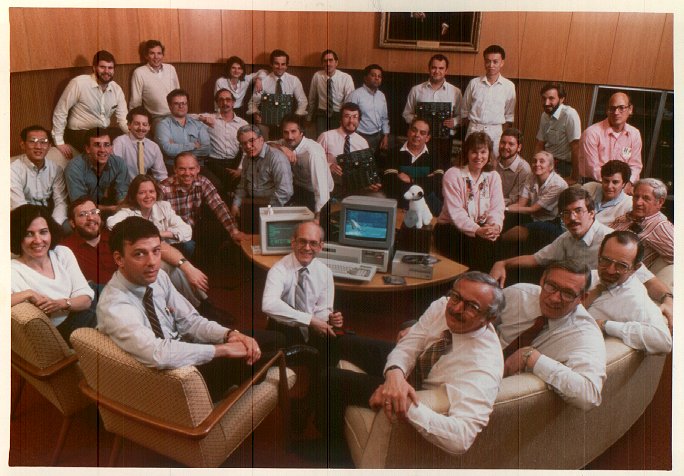
Kaiman (closest to bottom) before Intel bought DVI and moved the team to the new Princeton Operation.
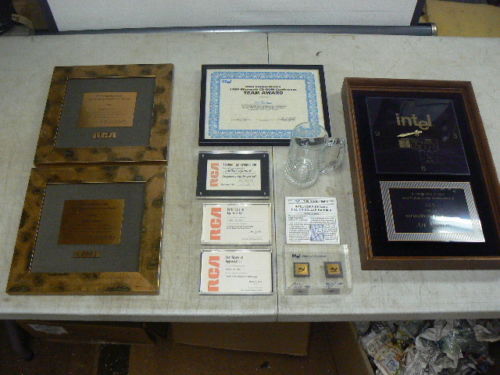
Art Kaiman's contribution lives on in the MMX instruction sets on billions of IA-32 compatible CPU's unofficially named for MultiMedia eXtension, Multiple Math eXtension, or Matrix Math eXtension.
- Mr. Kaiman's diplomas: Rutgers - The State University Newark College of Arts & Sciences, BA, 1963 and Stevens Institute of Technology, Master of Sciences (Mathematics), 1966
- There are 10 artifacts in this collection: All were acquired as a group from Kaiman's estate.
- RCA Laboratories Outstanding Achievement Award, 1973, Arthur Kaiman, For contributions to a team effort in the design, development, and application of new commercial minicomputer software, signed Wm Webster, VP, RCA Laboratories. Plate and RCA badge mounted in a mottled brass frame, 11-5/8" x 11-1/8", custom framed by A Gallery, Salt Lake City, Utah, good condition but the plate is slightly crooked
- RCA Laboratories Outstanding Achievement Award, 1974, Arthur Kaiman, For contributions to a team effort in the development of a multiprocessor software system for television broadcast automation, signed Wm Webster, VP, RCA Laboratories. Plate and RCA badge mounted in a mottled brass frame, 11-5/8" x 11-1/8", custom framed by A Gallery, Salt Lake City, Utah, good condition
- RCA Technology Symposium, This certificate is awarded to Arthur Kaiman for planning, organizing and conducting the Computers in Mfg. Symposium. Signed Wm. J. Underwood, Director, Engineering Professional Programs and H.K. Jenny, Manager, Engineering Information. Acrylic plaque with black background, 6" x 4-1/2", good condition with light scratches.
- RCA Certificate of Appreciation, This certificate is awarded to Arthur Kaiman for the colloquium presentation Manufacturing and Productivity - Do It Right the First Time !!, May 11, 1982, Colloquium Committee, David Sarnoff Research Center. Acrylic plaque with black background, 5-1/2" x 3-1/2", good condition with light scratches.
- Ceramic Coaster: Printed on front is a mock newspaper article with the headline: Intel Corp. Breaks Billion Dollar Barrier (this coaster is in the Computer History Museum - View). Intel's revenue first passed $1 billion in 1983. 4-1/4" square with cork backing, good condition.
- RCA Certificate of Appreciation, This certificate is awarded to Arthur Kaiman for the colloquium presentation Digital Video Interactive Technology, March 31, 1987, Colloquium Committee, David Sarnoff Research Center. Acrylic plaque with black background, 5-1/2" x 3-1/2", good condition with light scratches.
- Intel Corporation's 1989 Microsoft CD-ROM Conference Team Award presented to Art Kaiman. Intel recognizes your outstanding contribution on the 1989 Microsoft Conference. It was the most successful ever. Signed Dave House, Bob Brannon, and Rick Stauffer. Framed certificate, 11-5/8" x 9-1/8" overall, good condition.
- Intel Princeton Operation, Intel A82750PA and Intel A82750DA, PRO 750 ADP i750 F.C.S., July 21, 1989. 2 computer chips suspended in an acrylic block, 5" x 3-1/2" x 1-3/8", light scratches and the left chip is slightly crooked in the block. This item is pictured in Manifest Technology's DVI Technology Products Intel PRO750 Product Family (1989) online page (view). This item commemorates the first customer shipment of this product.
- Intel PRO DVI Technology, Happy Holidays, 1990. Clear glass mug, etched, 5-3/4" high, good condition.
- Intel AVK, In recognition of your contribution to the development of AVK and the ActionMedia II Products, Art Kaiman. Clock, black finished brass face with etched to brass numerals, logo, and pictorial representation of the product; separate black finished brass plaque with silver decoration, etched to brass; black felt background, deep brown wood frame, 12" x 18" x 2", missing the minute hand and cap, it also needs cleaning, good otherwise. This clock commemorates the introduction of AVK and ActionMedia II as part of the DVI project between about 1990 and 1992. CLICK HERE to see details.
- DVI team image from Manifest Technology.
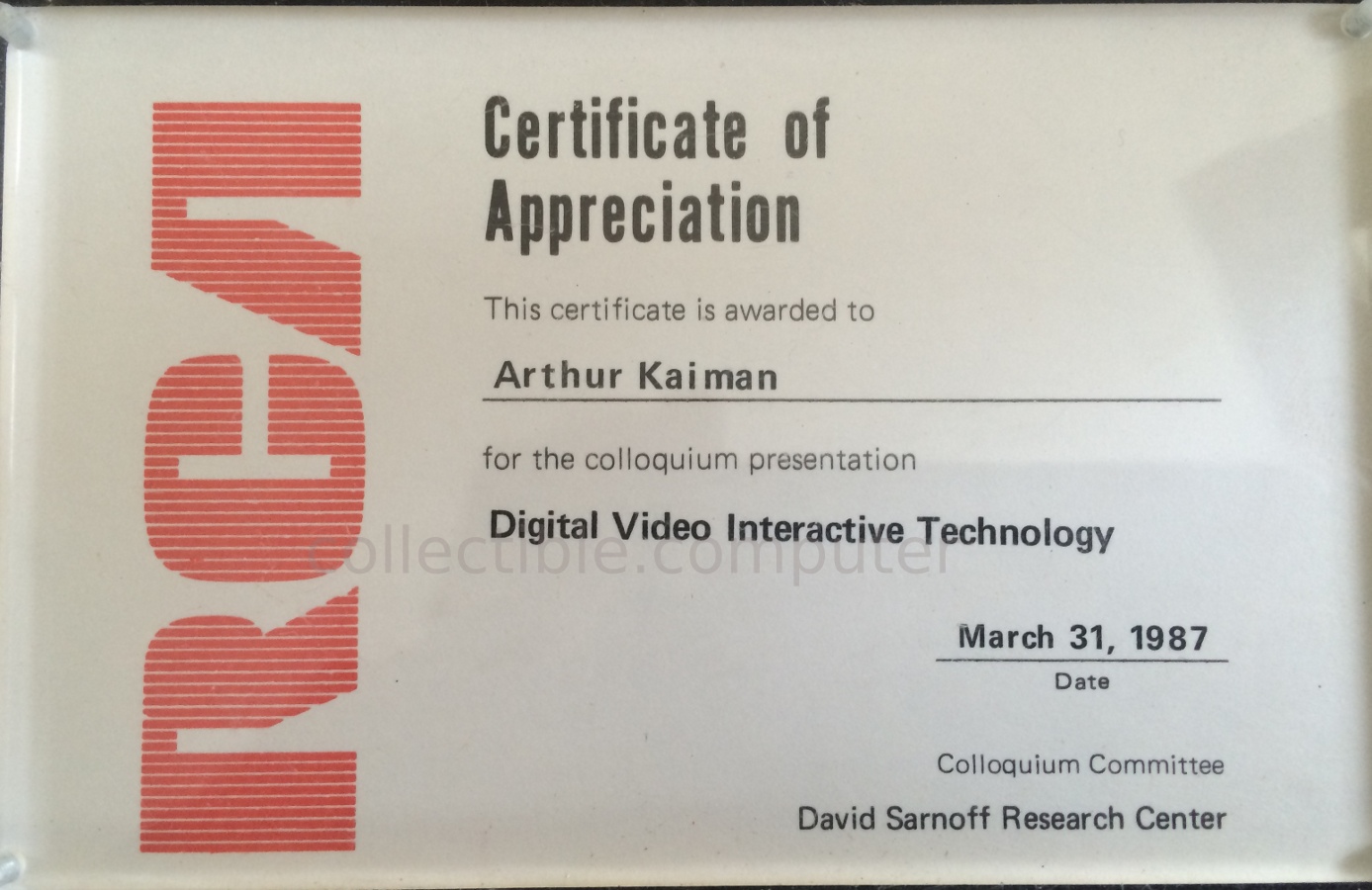
In the same month as the DVI Demo for Gates, Kaiman gets an award for DVI merit.
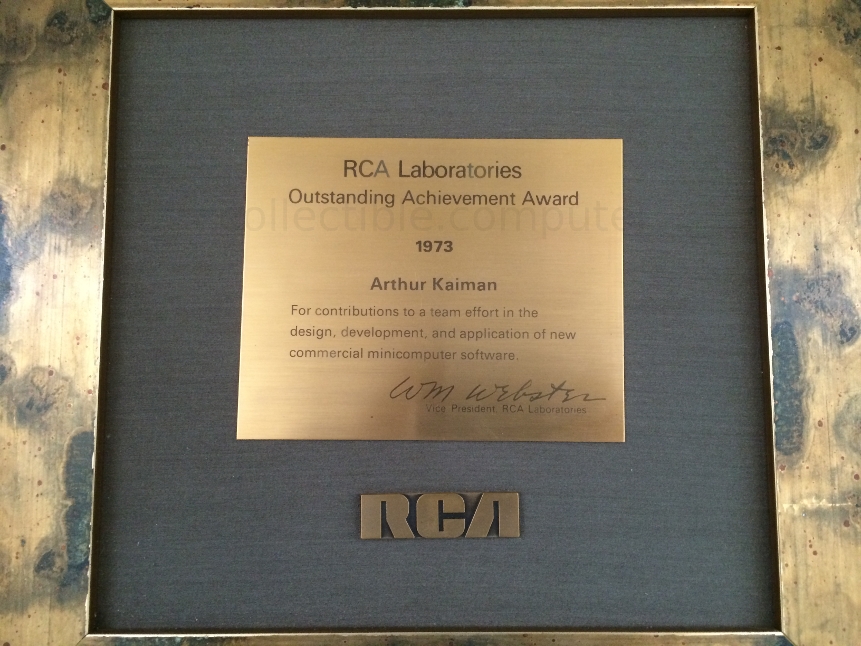
Stamped signature of Dr. William Webster. Webster joined RCA in 1946 after getting a degree from Union College, next door to the G.E. Homestead in Schenectady, N.Y. He went on to be a thorn in his neighbor's side holding patents in television, vacuum tubes, gas tubes, circuitry, and semiconductor devices.
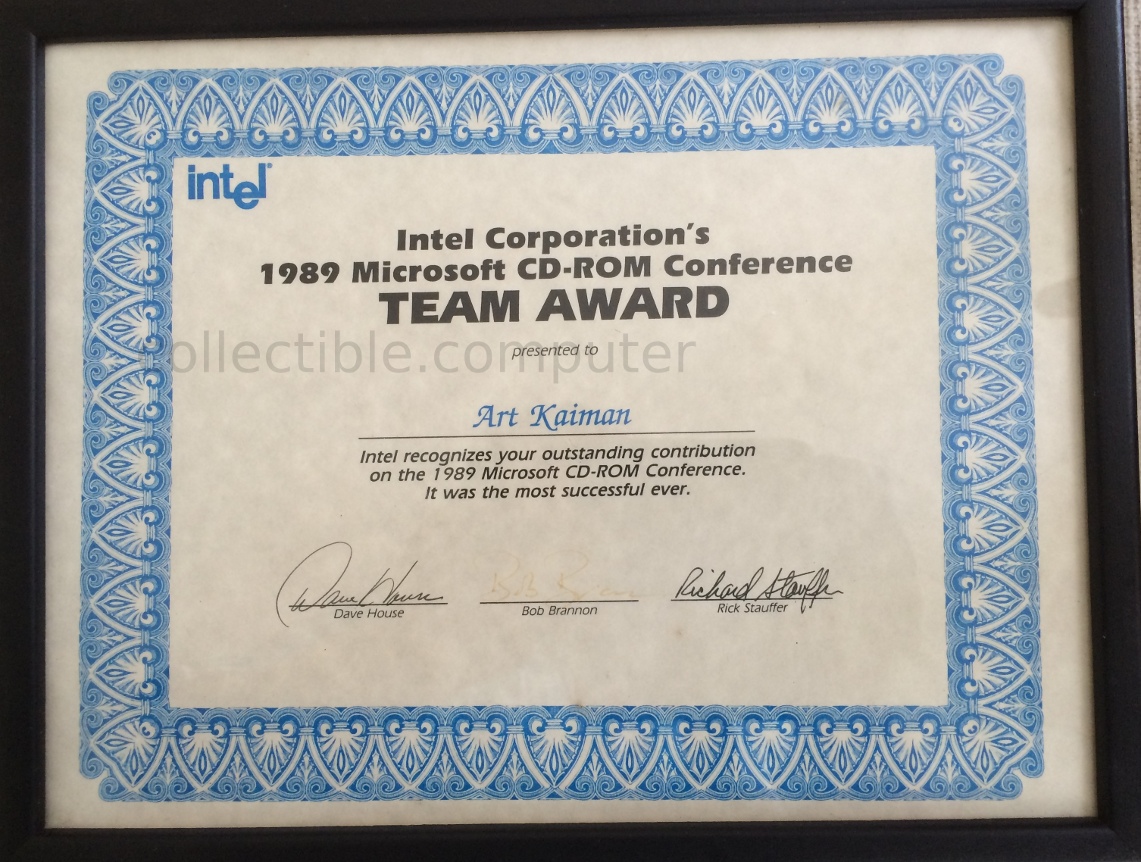
Personally Signed by Mr. "Intel Inside" Dave House. Rick Stauffer, marketing manager at PRO, was loosing the standards battle to Quicktime and MPEG by 1992.
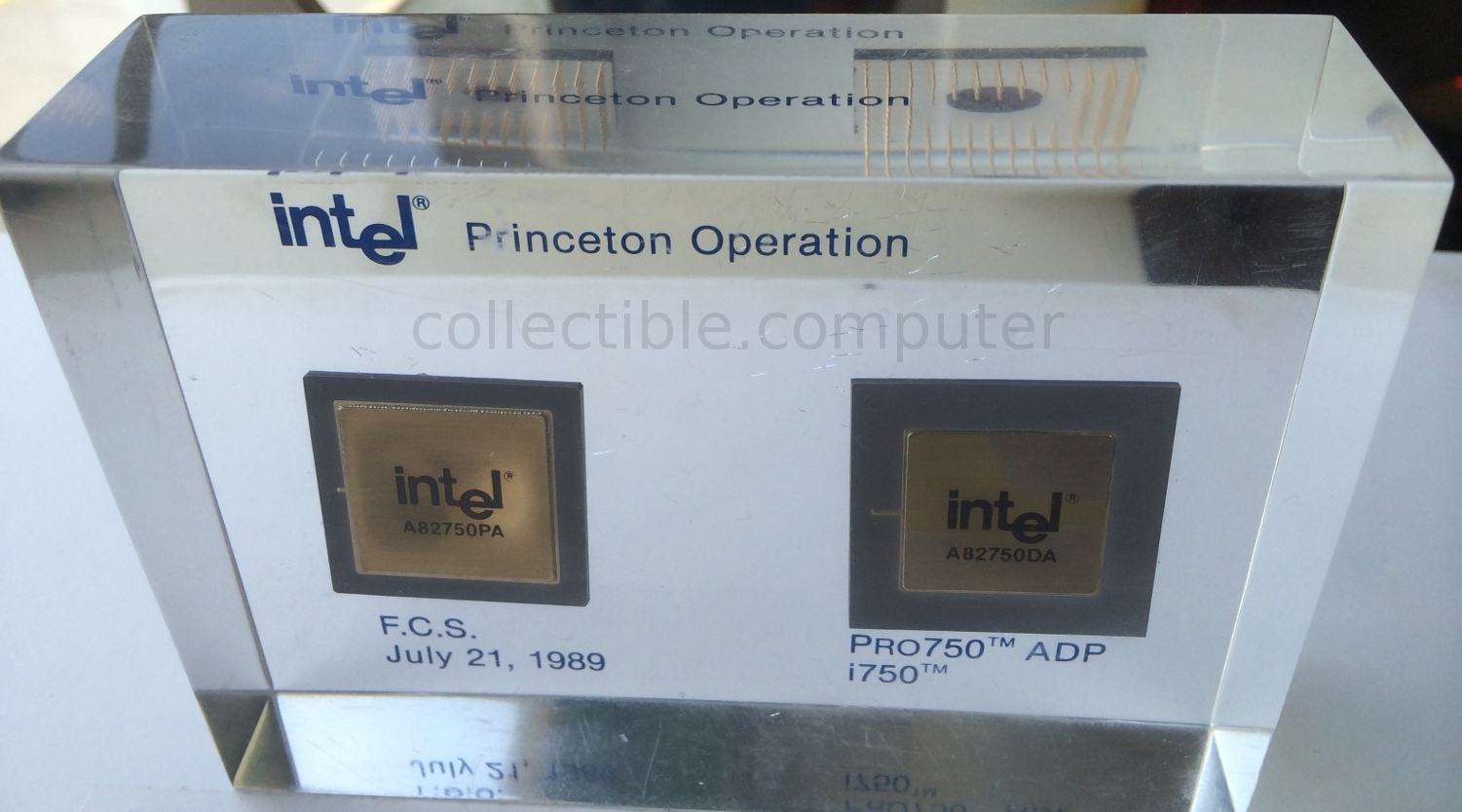
First i750 chip-sets "W #12". These packages look empty but the MMX they inspired packs a lasting punch.
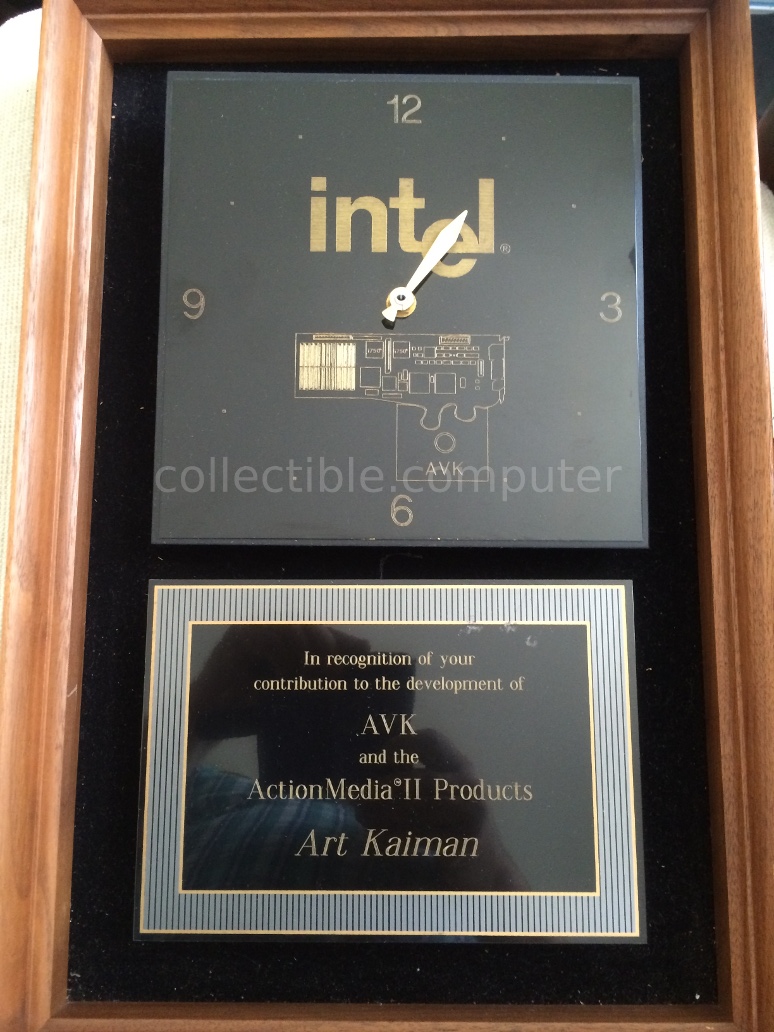
Time ticks down for Actionmedia II ostensibly because of high costs for both consuming and producing DVI video .
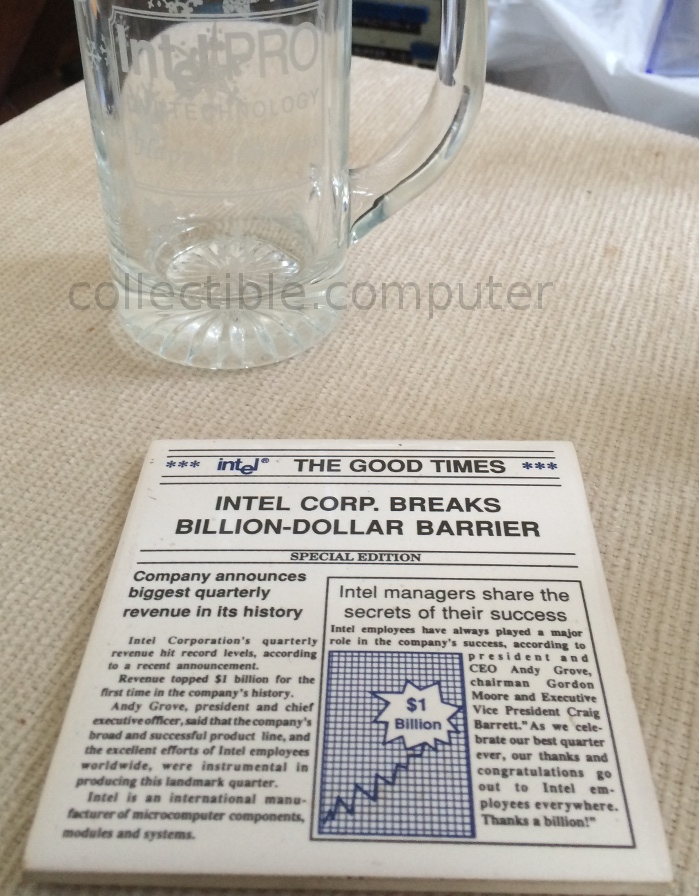
Intel SWAG!
In 1993 the Intel Princeton Operation (PRO) was finally closed relocating some but ending the role of Art Kaiman . Although DVI was ultimately not successful it paved the way for other formats like AVI that have made the PC a multimedia powerhouse.
Collector's Insight
IBM PS/2 Ultimedia Model 57 SLC and 77s are based on DVI technology. These originally included the $2K Actionmedia II board. They can be identified by front audio jacks and an early PS/2 CD-ROM drive. Also look for DVI and Ultimedia logos.
Subscribe to:
Posts (Atom)