For nearly a year with few interruptions, we have been running IBM Model 370 blinkenlights connected to a raspberry pi to randomize the pattern. So far exactly zero lights have burned out with the panel and raspberry pi still going strong. Very impressive longevity for the IBM panel lights!
The German term blinkenlights dates back to 1955 when IBM began to challenge UNIVAC for dominance in mainframe computers. The UNIVAC computers where mostly white lights but when IBM started lighting up the panel the full color spectrum flashed in perfect cadence.
I believe our IBM 370 Panel will outlive several raspberry pi's. Game on!
Monday, October 31, 2016

Wednesday, August 31, 2016
Intel Pentium III Prototype - Party Like It’s 1999
Intel's Pentium
Processors once powered 80% of the world's Personal Computers. When
a flaw was discovered in the flagship Pentium in 1994, CEO Andrew
Grove challenged customers to prove they deserved a replacement.
That was the kind of power the company had in the marketplace even getting the attention of FTC lawyers objecting to a CPU monopoly. According to watchdogs, shade was being thrown because of embedded processor serial numbers that were hard to kill. In fact this prototype was sent to developers like Rainbow Systems hard at work invading your privacy.
That was the kind of power the company had in the marketplace even getting the attention of FTC lawyers objecting to a CPU monopoly. According to watchdogs, shade was being thrown because of embedded processor serial numbers that were hard to kill. In fact this prototype was sent to developers like Rainbow Systems hard at work invading your privacy.


This surviving Katmai prototype "White Box" contains one of the first Pentium III's - without a way to disable the embedded serial number in the BIOS. According to its wiki, Rainbow Systems, CA used early PSN prototypes to develop software to tie computers with names for the NSA.


This Prototype uses an ES Pentium II Katmai 500 Mhz and 440 BX Chipset
The
PowerPC Alliance and Advanced Micro Devices introduced new product to loosen Intel's grip on the CPU market. Without a RISC processor of his own, Grove distributed a tweaked army of white box
prototypes to developers. They were improved cache versions of Intel's
Pentium II called Katmai running at 450 and 500 Mhz.
A surviving Katmai
"White Box" contains one of the first Pentium III's - without a way to disable the PSN in the BIOS. The dates on this prototype suggest that the
PII Katmai CPU was re-badged Pentium III as late as March 1999. I may even speculate that Intel was considering slipping this into a PII update with little fanfare.
PowerPC got stuck at 450 Mhz, failing to reach Apple's 500 Mhz speed claim. Despite
calling G4 a "Supercomputer on a Chip" Jobs was playing a
weak hand and knew it. AMD
CEO Jerry Sanders failed to take his goal of 30% market share. AMD
hit 26% at its high water mark in 2006.
Andy Grove remained
chairman of Intel until Intel's Haifa operation started on PIII
inspired Core Architecture. Moore’s Law is kept in full force today
thanks to some incremental work creating the Pentium III.
Sunday, July 31, 2016
IBM Interleaves Core Memory for 360-91.
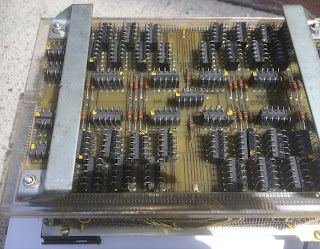
Built to compete with Seymour Cray's CDC 6600 supercomputer, the IBM 360 Model 91 was the fastest computer available in 1968. It uses 5 execution units with interleaved core memory like the module below. The first one delivered to the Goddard Flight Center helped land men on the moon.


YMF - 2196704
16-way interleaved memory type from 360 Model 91
"The main memory is organized into 16 interleaved elements, so that the CPU may start a memory cycle with a different element every 60 nanoseconds instead of waiting the full 780 nanoseconds. This means that the CPU will rarely get a "busy signal" from the memory, and few machine cycles are wasted waiting for data." - IBM Archives.

Bottom of the module is stackable
Another YMF - 2196704 8K Density board can be seen at the Computer History Museum in CA.

Red cores from another plane

It just missed fitting in a 9.7" iPad box!
Thursday, June 30, 2016
Robomation Intelligence Computer or IRI P256
Move over Google Glass and Oculus Rift. Robot vision has been around for a long time.
James Cameron’s final battle with the Terminator occurs in a fully Robotic factory with vintage Bots from the 1980’s. Here are some early Robotic brains staring with the IRI 256.
This 1980’s Robot is based on the same brain as the original Mac but with a zero wait state 1 MIP MC68000 version of the chip. It can actually visualize objects in low-res grayscale. The company published some interesting rules of Robotics. This microcomputer was Torso mounted using a 4G, UNIX-based API called Robotic Control Language. There was also a safety protocol inhibiting the Robot’s behavior around its human handlers.
The company went broke right around the time they received a patent for Robot Vision so it was assigned to a stronger company. Which brings us to our next item. GE Fanuc
James Cameron’s final battle with the Terminator occurs in a fully Robotic factory with vintage Bots from the 1980’s. Here are some early Robotic brains staring with the IRI 256.
This 1980’s Robot is based on the same brain as the original Mac but with a zero wait state 1 MIP MC68000 version of the chip. It can actually visualize objects in low-res grayscale. The company published some interesting rules of Robotics. This microcomputer was Torso mounted using a 4G, UNIX-based API called Robotic Control Language. There was also a safety protocol inhibiting the Robot’s behavior around its human handlers.
The company went broke right around the time they received a patent for Robot Vision so it was assigned to a stronger company. Which brings us to our next item. GE Fanuc
Tuesday, May 31, 2016
Former Zilog Engineer Talks Prototype Survivor
I recently had a chance to ask a former Zilog engineer a few questions about his remarkable single board prototype I had just acquired for the C.C. "permanent collection". This single board computer provided a 16K reference design for 8-bit home computers and arcade games.
Zilog is one of the few platforms in the world where vintage collectors and active developers lust over the same toasted sand. The QUIP packaged Zilog Z8-02 made in 1979 commands $500 because it is not only highly collectible but in short supply for a replacement part.
Super-optimized ZNEO covers much of the same territory Intel's 8086 did back when the Battle of the 80's was raging but outperforms modern RISC. The company's current Icebox dev tools owe their existance to a prototype single board computer created in 1978 to test the 4MHz Z80A.
According to the retired engineer, "When CPU performance elevated from 2.5 MHz to 4 MHz, this hand-built wire-wrap prototype was built to verify the design improvements and validate the functionality under in-circuit emulation.
The emulator plugs into the CPU socket, providing the engineer a portal into the operation of the hardware and software. A boot prom allowed serial port access with an improvised DC-DC converter modified to provide the bipolar RS-232 output voltages. At the time, emulators were the best way to check out new hardware as they pioneered the debug tools now taken for granted.
Placed on the included display stand, this respectable and rare relic speaks to the heady days of the Microprocessor Revolution -- visible proof that the March of Progress found continuity through these kinds of steps -- prototype design and implementation for validation (prior to simulators).
History's critical path temporarily vectored right through this particular prototype board which spearheaded the drive for next-level performance in the competitive 8 bit CPU marketplace dominated by Intel and Zilog. It proved the process improvements to NMOS IC fabrication with 4" wafers could reduce the manufacturing costs as well as increase the raw processing bandwidth.

This board contains the very custom Zilog clock driver chip required to produce a clean 4 MHz square wave with sufficient amplitude. Only produced for the 4 MHz Z80 CPU prototypes."
The engineer recounted the glory days of the 8-bit CPU wars. "It was a time of excitement and revolution!" "Sharing with the like minded makes it exciting!"
In a follow-up email the engineer who lives on a small island off Washington State wrote a heartfelt remeberance about his former colleage who built the board.
Thank you very much for the interest in the historical roots of the Zilog board. Your expertise in this area is most satisfying!
When Zilog introduced the 4 MHz Z80A, there were several issues that arose. The first problem was the clock input requirements. The solution was to build a little two transistor driver hybrid IC which is the little blue sip on the lower left.
The 16 MHz oscillator gets divided by four by a TTL device (the 9316) and then presented to the CPU via the clock driver. That proved very useful for reliability.
The cpu socket was used in conjunction with an in-circuit emulator for code development and the resulting code is buried in the the 2716 eprom.
The board was actually built by a colleague who worked on support hardware and software while at Zilog. He died a few years ago, so this was part of his work product that he passed along to me prior to his passing.
He was a dear friend and his work helped shape the future of microprocessor based systems.
Zilog is one of the few platforms in the world where vintage collectors and active developers lust over the same toasted sand. The QUIP packaged Zilog Z8-02 made in 1979 commands $500 because it is not only highly collectible but in short supply for a replacement part.
Super-optimized ZNEO covers much of the same territory Intel's 8086 did back when the Battle of the 80's was raging but outperforms modern RISC. The company's current Icebox dev tools owe their existance to a prototype single board computer created in 1978 to test the 4MHz Z80A.
According to the retired engineer, "When CPU performance elevated from 2.5 MHz to 4 MHz, this hand-built wire-wrap prototype was built to verify the design improvements and validate the functionality under in-circuit emulation.
The emulator plugs into the CPU socket, providing the engineer a portal into the operation of the hardware and software. A boot prom allowed serial port access with an improvised DC-DC converter modified to provide the bipolar RS-232 output voltages. At the time, emulators were the best way to check out new hardware as they pioneered the debug tools now taken for granted.
Placed on the included display stand, this respectable and rare relic speaks to the heady days of the Microprocessor Revolution -- visible proof that the March of Progress found continuity through these kinds of steps -- prototype design and implementation for validation (prior to simulators).
History's critical path temporarily vectored right through this particular prototype board which spearheaded the drive for next-level performance in the competitive 8 bit CPU marketplace dominated by Intel and Zilog. It proved the process improvements to NMOS IC fabrication with 4" wafers could reduce the manufacturing costs as well as increase the raw processing bandwidth.

Z80 Verification Prototype
This board contains the very custom Zilog clock driver chip required to produce a clean 4 MHz square wave with sufficient amplitude. Only produced for the 4 MHz Z80 CPU prototypes."
The engineer recounted the glory days of the 8-bit CPU wars. "It was a time of excitement and revolution!" "Sharing with the like minded makes it exciting!"
In a follow-up email the engineer who lives on a small island off Washington State wrote a heartfelt remeberance about his former colleage who built the board.
Thank you very much for the interest in the historical roots of the Zilog board. Your expertise in this area is most satisfying!
When Zilog introduced the 4 MHz Z80A, there were several issues that arose. The first problem was the clock input requirements. The solution was to build a little two transistor driver hybrid IC which is the little blue sip on the lower left.
The 16 MHz oscillator gets divided by four by a TTL device (the 9316) and then presented to the CPU via the clock driver. That proved very useful for reliability.
The cpu socket was used in conjunction with an in-circuit emulator for code development and the resulting code is buried in the the 2716 eprom.
The board was actually built by a colleague who worked on support hardware and software while at Zilog. He died a few years ago, so this was part of his work product that he passed along to me prior to his passing.
He was a dear friend and his work helped shape the future of microprocessor based systems.
Saturday, April 30, 2016
First Network Switch : 1881 Paris Award Restored
Familiar to historically oriented science buffs is the 1879 patent issued for the first automatic telephone exchange to McTighe and Connelly Brothers. Previously lost is one of the copper second place medals received by the group at the first electrical exposition in Paris. It has all three of the participant's names misspelled.
Eight stations were set up to dial each other without intervention of a manual switchboard. McTighe the inventor of the automatic switch was also a lawyer at the firm. One hundred years later Onyx Systems (Same founder as Zilog) would make the first UNIX eight user microcomputer.
Eight stations were set up to dial each other without intervention of a manual switchboard. McTighe the inventor of the automatic switch was also a lawyer at the firm. One hundred years later Onyx Systems (Same founder as Zilog) would make the first UNIX eight user microcomputer.
Most of the exhibits from that time are lost to history but as fate would have it the partners law firm was located near the Smithsonian. The complete exhibit is preserved for future generations in the American History Museum although not currently on display.

Large copper second place medal awarded in 1881. Restored medal has less patina.

Blinkenlights are everywhere as even the lighthouse has a red-white flasher.
.
During the summer of 1881 the first science festival ever held for electrical devices was about to get underway in Paris. The setting was the Palace of Industry built by Emperor Napoleon III for the 1855 World’s Fair to rival the Crystal Palace in London.
American participants included a young Thomas Edison literally sweating problems with his long legged Mary Anne and Alexander Graham Bell phoning the opera two blocks away for a live telecast. The building was steamy hot under a roof of cast iron and plate glass. One half of the building was devoted exclusively to French electrical exhibits. A first ever congress of electrical engineers had gathered to sort out terms for Volt, Ohm and Amp while also testing light bulbs from Swan and Edison for the best efficiency.
American participants included a young Thomas Edison literally sweating problems with his long legged Mary Anne and Alexander Graham Bell phoning the opera two blocks away for a live telecast. The building was steamy hot under a roof of cast iron and plate glass. One half of the building was devoted exclusively to French electrical exhibits. A first ever congress of electrical engineers had gathered to sort out terms for Volt, Ohm and Amp while also testing light bulbs from Swan and Edison for the best efficiency.
Thursday, March 31, 2016
Caelus Memories Rewind
Attack of the clones could describe Caelus Memories' plug compatible drive that was built with the encouragement of IBM by ex-RAMAC employees in San Jose. The actuator bears a strong resemblance to the RAMAC 305 but with a fixed vertical movement.
A facility was purpose-built in 1967 a close distance from IBM's own San Jose plant. While Caelus got required licensing, IBM was hit in 1970 by the defection of Gene Amdahl, a company fellow who built a 370 compatible mainframe.
Drive technology changed rapidly as by 1973 the company was competing with Winchester drives and the floppy disk. Even the Greek god of invention was no match for obsolescence. The site where the factory once stood is now a medical test lab.
Subscribe to:
Posts (Atom)